
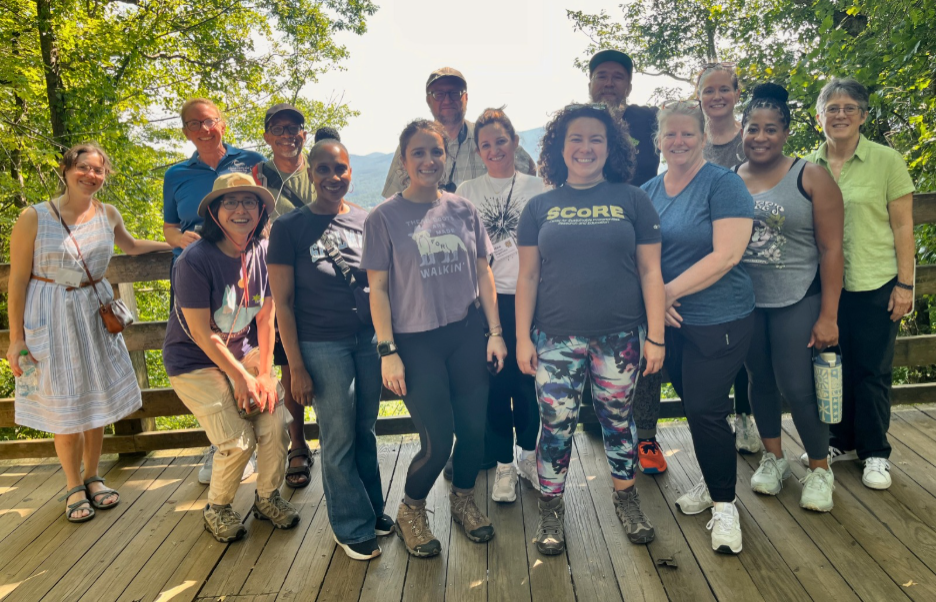
From August 10-12, 2026, a group of faculty, researchers, institutional leaders, and community-based partners gathered at Amicalola Falls State Park in North Georgia for a three-day retreat with a shared goal: to braid together the state’s existing and rich strands of community-engaged research partnerships and projects. The retreat was sponsored by GT’s College of Design and the Institute for People and Technology. We took as our objectives the: 1) formation of a network of researchers and partners doing CER across Georgia; 2) creation of a resource repository and newsletter; 3) dreaming up of fundable statewide CER initiatives. More broadly, the group aimed to build excitement around working together, despite the diverse challenges facing partners and researchers in their various institutional contexts across the state. What emerged from our three days together is the Georgia Community Engaged Research Partners (G-CERP), a new and growing coalition of communities and academic institutions committed to strengthening both our processes for and outcomes of CER in Georgia.
Over the course of the retreat, participants built a shared vision organized around eight pillars: a clear and specific mission, a realistic execution plan, storytelling that amplifies impact, centering communities as leaders in research, integrated and collaborative trainings, effective, shared resources and tools, strategic and sustainable funding, and a comprehensive student CER curriculum. Each pillar reflects a concrete commitment — from co-developing training programs to creating pathways for communities to initiate and lead their own research. Together, the pillars form the scaffolding for a coalition designed to move us across our institutional and geographic borders and to identify resources to fuel that collaborative work. The founding group brought existing infrastructure and strong local relationships to the table: an innovative faculty fellows “exchange” program at Columbus State, a robust menu of trainings at Morehouse School of Medicine, a “research center” bringing Emory and Georgia Tech partners together for resilience and public health projects in Brunswick and the Community Engaged Research Council at GT are just a few of the ongoing initiatives that participants shared and linked together during the retreat.
The retreat convened faculty and staff from Emory’s Rollins School of Public Health, KSU’s School of Architecture, Savannah State’s Office of Sponsored Projects, Morehouse School of Medicine’s Community Health and Preventative Medicine program, Spelman’s Department of Environmental and Health Sciences, GSU’s Geosciences Program (and the NSF-funded CSAW project), the Center for Teaching and Learning at the College of Coastal Georgia, the Office of Student Success at Columbus State, the Rural Studies Institute (formerly housed) at the Georgia College and State University, the Office of Undergraduate Research at Spelman and several offices at Georgia Tech.These included SCoRE (home to the retreat co-facilitators, Katie O’Connell and Ruthie Yow), Enterprise Innovation Institute, the Institute for People and Technology, Brook Byers Institute for Sustainable Systems, the Renewable Bioproducts Institute and CEAR Hub, working on Georgia’s coast.
With the retreat behind them, G-CERP's founders are now inviting others to join the work as well as creating cases for funding – arguing that no similar body exists to link and amplify powerful community engaged research projects unfolding across the state. The coalition seeks more members from more institutions, within the University System of Georgia and at colleges and universities outside it, and there are several ways in: reaching out to the GT-based facilitators, contributing templates, relationships, or funding leads, or attending the 2027 symposium (location and date TBA!), where founding members will welcome newcomers and continue to shape the network and advance its goals.